


Mindfulness is purposefully paying attention to the present moment. You observe basic things like your surroundings, your thoughts, your feelings, anxiety, stress, and so on.
However, if you are mindful, you don’t allow them to disturb or overwhelm you. In mindfulness, you are non-judgmental.
You can achieve such a state through meditation and similar practices. Being mindful helps you to manage your feelings, stress, and improve focus.
It helps you regulate your emotions, such as fear and greed. In short, you are in better control of yourself without putting in additional effort.
We’re living in a world that is so advanced that almost everything is available at our fingertips, with just a few taps on our smartphones.
Over the past few years or so, one such technology that is transforming almost every area of our lives is Artificial Intelligence, or AI in short.
One thought that arises is whether we can use AI for mindfulness?
Artificial Intelligence (AI) is nothing but a highly advanced technology that mimics the human mind and provides responses that are based on experience and continuous learning.
Technically, it uses automation, data analysis, and machine learning for this purpose.
With huge quantities of data available and continuous learning from all the new data being generated, AI can produce responses that are intelligent, highly accurate, and reflect human cognitive attributes.
Understanding how to use AI for mindfulness is key to leveraging this technology for mindful living, personal growth, and self-care.

Can AI Help in Mindful Living?
AI is a powerful tool that uses every possible technology towards intelligent automation. As in any other field, AI can also help in mindful living.
It can analyze feelings, thoughts, stress, and fear factors to suggest the best possible meditation and other relaxation methods.
Its machine learning abilities enable it to learn more about you as you interact with it and can provide personal and customized advice for leading a mindful life.
It can provide topics for journaling based on your current situation. It can provide self-care choices depending on how you feel at a given point in time.
AI can analyze your psychological and historical data and advise you on personalized remedies.
For example, you must have used popular AI platforms such as ChatGPT from OpenAI, Gemini from Google, and Grok from X.com. You can use them for your mindfulness objectives as well.
If you describe your situation and objectives, these AI platforms can provide you with guidance. Whether you need journaling prompts or self-care advice for your situation, these platforms can come up with solutions that you would find useful.
However, before you use AI platforms for mindfulness, you must first make a choice that you would like to change your life, and choose to live with mindfulness.
Once you are on the path of mindful living, you will find AI has a lot to offer.
There are several mindfulness apps that use AI to offer more personalized and customized techniques for mindful living.
6 Simple Tips to Use AI for Mindfulness In Your Daily Life
If you use a mindfulness app, it is likely that it has AI features. The convergence of AI and mindfulness has given rise to powerful new mindfulness tools.
Take the example of journaling prompts. Here, AI comes across as a responsive and non-judgmental coach.
Instead of struggling with mental blocks when choosing or writing about a topic, AI can dig deeper into your life through expressed moods, concerns, anxieties, and stress, and provide relevant journaling topics that inspire you to express yourself.
Instead of traditional topics such as “Write three reasons why you should be grateful for your day today”, you can explain your anxiety and stress related to your current project, and the AI tool can offer a range of relatable topics.
This personalization is what is driving daily life mindfulness with AI tools.
For example, it may offer you to write three steps that you can take tomorrow to reduce your stress about your current project.
Here, AI customizes its response for you. It makes journaling into a dynamic conversation, and it encourages you to explore and identify blind spots and emotional patterns.
It helps you to awaken to mindfulness techniques like self-compassion and gratitude.
Here are 6 simple tips to use AI for mindfulness in your daily life.
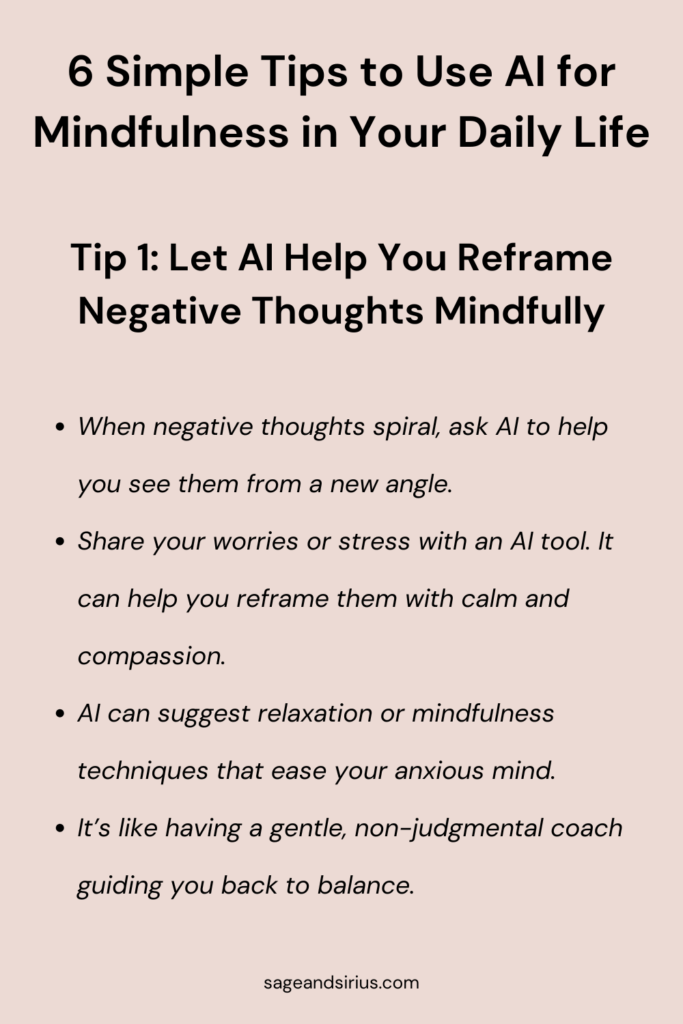
Tip 1: Let AI Help You Reframe Negative Thoughts Mindfully
With so many things to deal with on a busy workday, it is easy to get caught in the web of negative thoughts.
If you don’t deal with it proactively and with mindfulness, one negative thought can lead to another, and soon you are trapped in a vicious circle of many negative thoughts.
You are never able to come out of it. You find yourself constantly worrying and disappointed. It can lead to acute depression. Can AI help you at all?
Yes, if you provide prompts about your current chain of negative thoughts that’s keeping you down, the AI assistant can explain your thoughts and anxiety from different perspectives.
This is one powerful way to practice daily life mindfulness with AI tools.
It can help you know your thoughts in a new and potentially positive light, unburden you of the many negative thoughts that keep your mind occupied, and let in some fresh thoughts and perspectives.
For example, if you’re worried about a presentation you think you have not been able to execute perfectly, you can state it to your AI assistant for help.
You will be surprised to see how AI brings different positive perspectives to the problem. You are able to find a few relaxation techniques that can help you break free from the chain of heavy and negative thoughts.
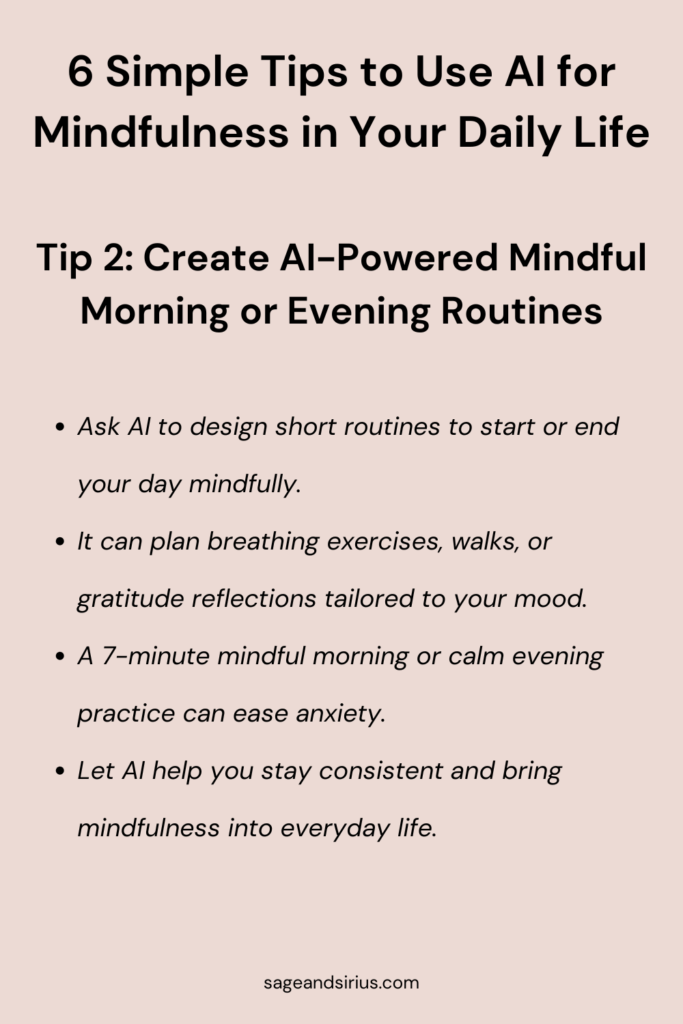
Tip 2: Create AI-Powered Mindful Morning or Evening Routines
The chain of negative thoughts and stress can be broken by physical activities. And, it can begin with small acts like a 2-minute breathing session, a morning walk with some mindfulness music, and so on.
If you do these things in the morning and the evening, you are likely breaking the old thought process and bringing in fresh perspectives.
Your AI assistant can help create a weekly routine of such mindfulness activities for you. Once you embark on such a routine and stick with it, your negative thoughts, anxiety, and stress will soon start fading and vanishing.
The great thing about an AI assistant is that you can tell it all that’s worrying you at any point in time. If you’re sad or melancholic during the day, your AI assistant can provide some ideas to break free from it, making these simple AI mindfulness practices immediately accessible.
For example, you can ask the assistant: “Create a 7-minute mindful morning routine to reduce pre-work anxiety”, or “Design a 5-step evening routine focused on gratitude and sleep preparation.”
Tip 3: Ask AI to Help You Notice Triggers and Patterns
Do your anxiety and stress have a pattern? Are there any hidden triggers? You may not identify them on your own.
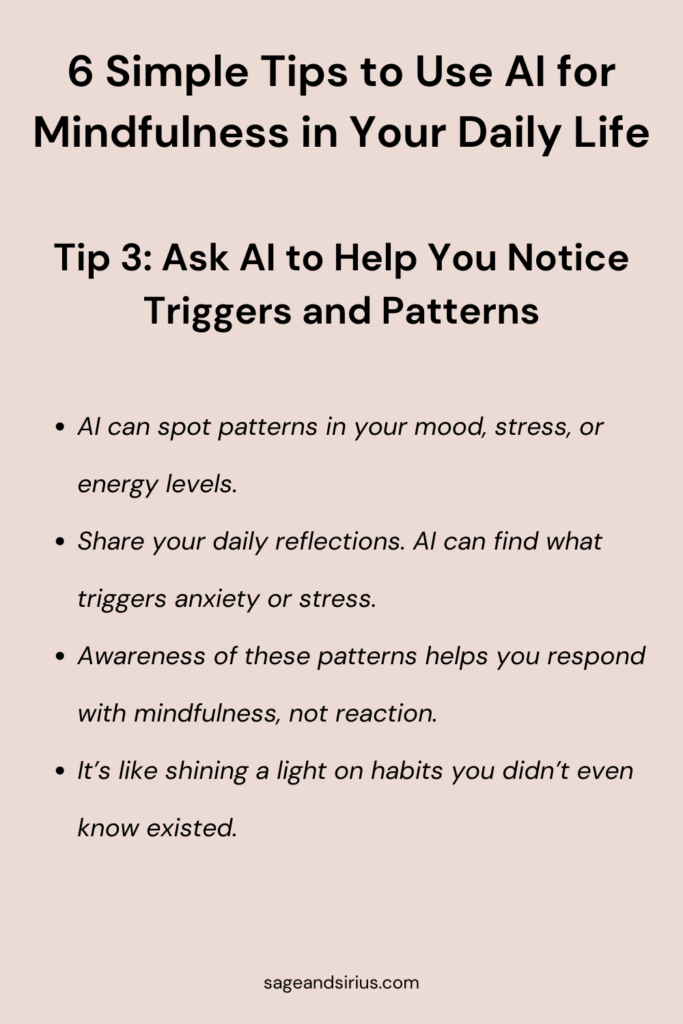
However, if you provide detailed and recurring data to the AI assistant, it may provide a detailed and deeper analysis.
For example, do you feel extra-stressed on Monday mornings or after a meeting with a particular person or team? Is it that you don’t get a good sleep after a coffee post-midnight?
On the face of it, you may not identify the real trigger to your problems. But if you tell the AI chatbot your problems in detail, it can identify the triggers, subtle or complex!
This insight is crucial for implementing targeted, simple AI mindfulness practices.
It can also help you with techniques on how you can overcome them. The more data you provide to the AI assistant, the more in-depth the analysis it will provide.
Once you know the triggers to your problems, you may be more mindful in managing them.
Tip 4: Use AI to Plan Mindful Breaks That Fit Into Your Day
In a busy work life, there is no time for a break. If at all you take a break, it’s a long leave.
Once you come back to work after such long breaks, you confront the same work pressure and office environment, making you relapse into the routine feeling of fatigue, stress, and anxiety. Can you find a solution to this?
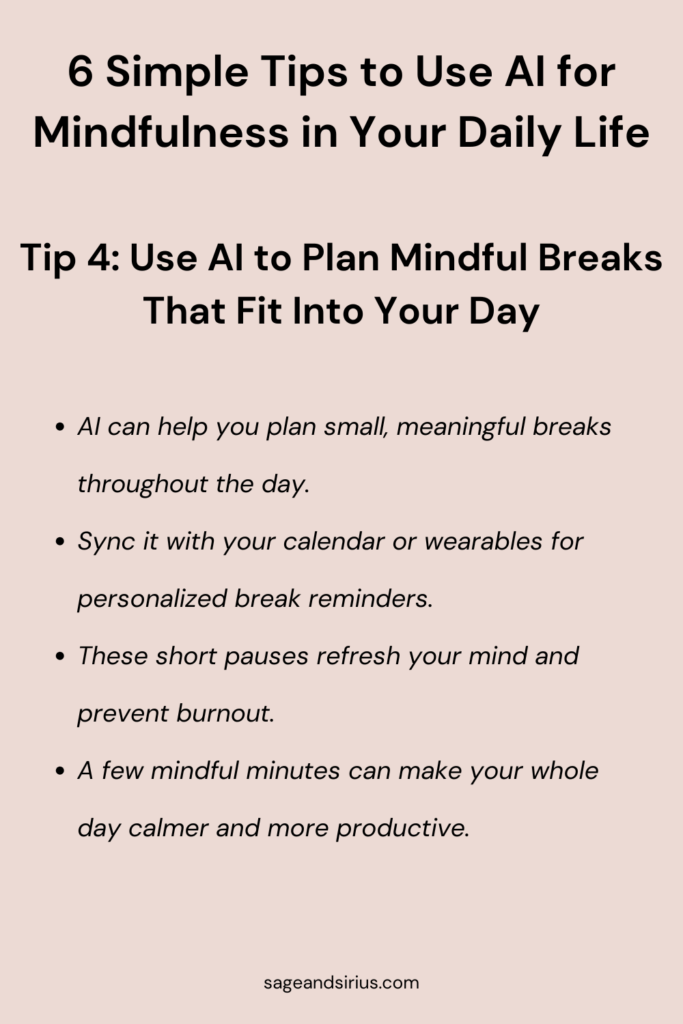
If you ask your AI assistant, it may come up with several ideas for small but mindful breaks during your workday that can help manage your fatigue, stress, and anxiety. This is a practical application of daily life mindfulness with AI tools.
You can give AI access to your digital calendar and data from wearables and digital apps, and it can tell you exactly when you can take pauses to relax and regain control over your work life.
Instead of generic break calls like it’s time to go for a break, meaning a long holiday, small breaks during your daily life that refurbish your energy and zeal are more productive and practical, proving the immense value of daily life mindfulness with AI tools.
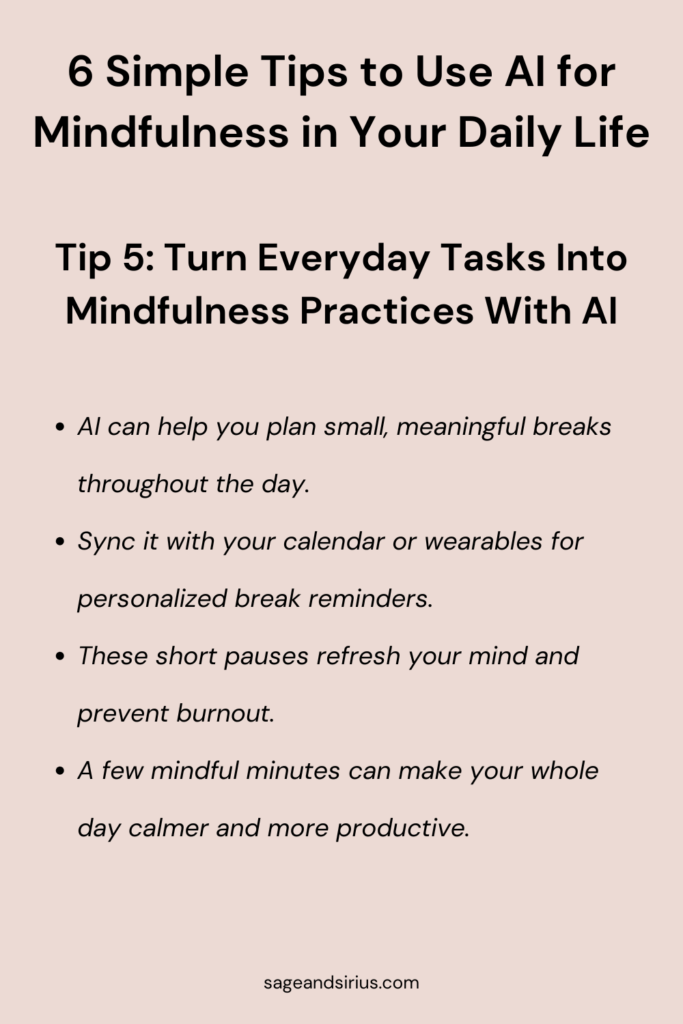
Tip 5: Turn Everyday Tasks Into Mindfulness Practices With AI
Mindfulness is a lot about attention and presence. A restless or anxious mind will be lost in thoughts while doing work. On the contrary, with mindfulness, it’s possible to derive peace and purpose while doing routine, mundane jobs.
Based on your routine and other details that you provide, AI will suggest how you can achieve greater mindfulness while doing routine jobs. These are effective, simple AI mindfulness practices
For example, while taking your morning walk, you can either be totally occupied with your thoughts or choose to be more mindful about a certain thing.
It could be a piece of music, thinking about the surrounding greenery, or counting the number of people you come across. The AI assistant can help you design these kinds of focused activities, turning chores into simple AI mindfulness practices.
The idea is that you should be able to choose what your mind is occupied with. It lets you transform daily chores into mindful everyday tasks.
This is a great way to leave behind the chain of negative thoughts, stress, or anxiety that you are suffering from.
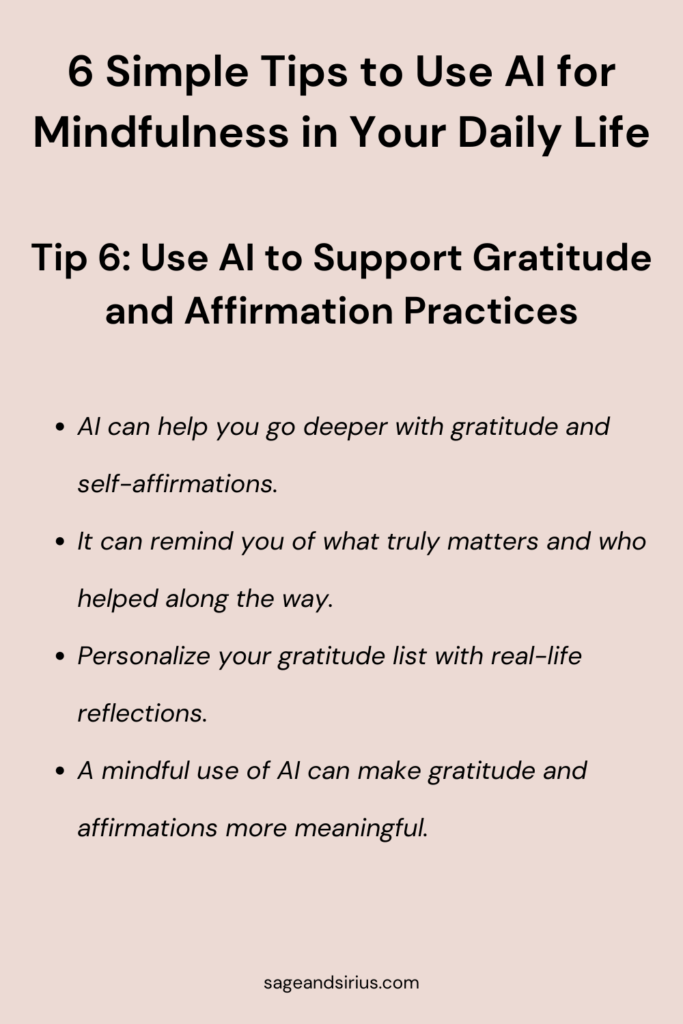
Tip 6: Use AI to Support Gratitude and Affirmation Practices
Your success at work doesn’t end there. It has a life beyond that. But only if you are mindful about it. Being mindful helps you identify and recognize the factors that led you to success.
Instead of thinking that “I am grateful to the team that made the success possible”, your AI assistant can help you go deeper and identify the exact reasons that made the difference.
This is a brilliant illustration of how to use AI for mindfulness to enhance gratitude.
Instead of being grateful to the entire team, it helps you to appreciate precisely what won you the day. The resilience of a certain colleague, the hard work of another, the extra time put in by someone, and so on.
The use of AI to discover these contributions makes your sense of gratitude and affirmations more real and effective, demonstrating a powerful application of how to use AI for mindfulness. It gives you a greater sense of satisfaction and lasts longer.
How to Be Mindful While Using AI
However, while AI has its benefits, it also has a downside that you will figure out as you interact with it. While you take the first steps to integrate AI into your mindfulness exercise, you should avoid sharing personal and specific information.
Also, you should not depend entirely on AI for your personal growth and mindful living.
The suggestions that AI offers make an impact on your subconscious immediately. You should know how much and what to take from its detailed suggestions, and be guarded and make conscious choices with AI.
You have to live and work with humans, where personal connections matter a lot. So, you should not ignore them altogether as you seek help and advice from AI.
Wrapping Up – 6 Simple Tips to Use AI for Mindfulness In Your Daily Life
Mindfulness is a practice of non-judgmental attention to the present moment. AI, with its capacity for continuous learning, has emerged as a valuable tool for mindfulness.
You may wonder how to use AI for mindfulness. Well, we have discussed 6 points in this blog for this purpose. These days, most mindfulness apps have integrated daily life mindfulness with AI tools.
You can use their simple AI mindfulness practices for relief from stress, anxiety, and negative thoughts in your daily life.




Leave a Reply