


All of us have very stressful days at work, and staying focused isn’t always easy. Here are some simple tips for practicing mindfulness at work that will help you stay present, reduce stress, and make your workdays more productive.

I live and work in Delhi NCR, which is an IT hub and there are so many office complexes in different parts of the city.
Each office complex has restaurants and cafes on the ground floor and offices in the building above. During lunch breaks or after work, people step out for a quick bite or a short walk.
Every time I’m out, I notice people rushing from one place to another, eyes glued to their phones, completely absorbed in emails, messages, or to-do lists.
Juggling back-to-back meetings, endless emails, and tight deadlines, all while running on caffeine and willpower.
To be honest, I’m also one of them. Most days, I’m also caught up in the same fast-paced routine. But it’s not just me, and it’s not just corporate employees. The same frantic energy is everywhere.
Parents rushing to pick up their kids, shuttling them from school to soccer practice, then to music lessons, then home to finish homework before starting all over again the next day.
Somewhere along the way, we started treating this nonstop hustle as normal. In fact, we wear it like a badge of honor, as if being busy all the time means we’re doing life right. But is it really?
Because this way of living is exhausting, it drains our energy, messes with our mental well-being, and makes it harder to focus on what’s in front of us.
Even when we’re not working, our minds are still stuck on emails, deadlines, or things left unfinished. It’s like we’re always on but never truly present.
This is exactly why practicing mindfulness at work isn’t just a nice idea but a necessity. And no, it doesn’t mean you need to sit cross-legged in your office meditating for hours.
It’s about making small and mindful changes to how you go about your day.
I’m sharing simple tips for practicing mindfulness at work because learning to be present might just be the most valuable skill we can have.
What Does Practicing Mindfulness at Work Mean?
Practicing mindfulness at work simply means being fully present in what you’re doing, rather than running on autopilot or feeling pulled in a hundred different directions.
It’s about focusing on one task at a time instead of multitasking, listening attentively instead of half-hearing conversations while checking emails, and responding to challenges with a clear mind instead of reacting impulsively.
Workplace mindfulness isn’t about eliminating stress altogether, it’s about handling it better. When you’re mindful, you’re more aware of your thoughts, emotions, and reactions.
You start noticing when your mind is racing, when tension builds up, or when frustration takes over. And that awareness gives you the power to pause, reset, and approach things with more clarity.
Whether it’s taking a deep breath before a meeting, noticing when your mind starts wandering, or simply being aware of how you’re feeling throughout the day, practicing mindfulness at work allows you to bring more calm and clarity into your daily routine.
When we’re mindful, we’re not just working, we’re fully present in the work we do. And in a world that constantly demands more from us, learning to be present can make all the difference.
What Are the Benefits of Mindfulness in the Workplace?
I actually have another blog where I’ve talked about the benefits of mindfulness in the workplace, and I’ll leave the link below if you want to dive deeper.
But in simple terms, practicing mindfulness at work helps reduce stress and increase happiness. A lot of our stress comes from either dwelling on the past or worrying about the future.
Mindfulness brings you back to the present moment so you’re not stuck in that constant cycle of overthinking.
When you’re mindful, your focus improves. You’re able to give your full attention to one task at a time without feeling overwhelmed by everything else on your to-do list.
This makes a huge difference in how productive and efficient you are throughout the day.
The importance of mindfulness at work also extends to communication. It helps you listen better, engage more thoughtfully in conversations, and build stronger relationships with your team.
And mindfulness isn’t just about work performance. It also impacts how you feel about your job.
When you’re fully present, work feels less like a never-ending grind and more like something you can handle with clarity and purpose.
Your stress levels drop, your decision-making improves, and you actually start feeling more in control of your day.
This is why some tips for practicing mindfulness at work can actually help you. The small changes in how you approach your work can completely change how you experience it.
Related Blog: Benefits of Mindfulness in the Workplace

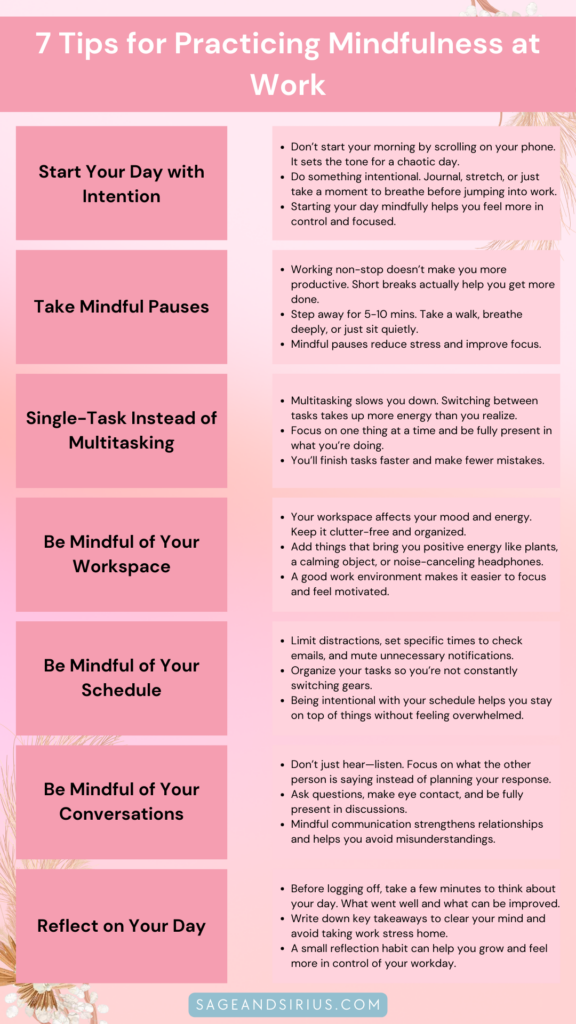
7 Simple Tips for Practicing Mindfulness at Work
I’m now sharing 7 simple tips for practicing mindfulness at work that have personally worked for me. You don’t have to follow them exactly. Just take what makes sense for you and try incorporating it into your workday.
Or you can take inspiration from them and come up with your own.
1. Start Your Day with Intention
One of the most important tips for practicing mindfulness at work actually starts before you even get to work, with how you begin your morning.
Most of us wake up and reach for our phones almost instantly. We start checking emails, scrolling through social media, or thinking about everything we have to do even before getting out of bed.
Without realizing it, we set the tone for a rushed and scattered day.
Instead, try starting your day with intention. Take a few moments in the morning to be present before diving into work mode. You don’t have to do anything complicated, just something that helps you ease into the day mindfully.
I like to journal in the morning because it helps me plan my day and clear my mind of any worries. Maybe for you, it’s drinking your coffee without distractions, stretching, or simply taking a deep breath before checking your phone.
The point is to begin your day with awareness instead of autopilot. When you do this, you carry that mindfulness into the rest of your workday, which makes it easy for you to stay present and focused.
2. Take Mindful Pauses
When work piles up, we tend to sit for long hours, glued to our screens, skipping meals, and pushing through without a break.
I do this too, especially on days when deadlines are tight or when my teammates are on leave. It feels like the only way to get things done, but honestly, working non-stop does more harm than good.
Taking mindful pauses throughout the day is one of the most effective tips for practicing mindfulness at work. Even short breaks of 5-10 minutes can improve your focus and productivity.
When you step away for a few moments, whether for a short walk, a coffee break, or just sitting with your eyes closed, your body gets a chance to recharge.
Working without breaks isn’t just mentally exhausting, it also affects your posture, increases stress, and reduces overall efficiency.
A simple deep breath before a meeting can help you stay present, while a quick stretch or a few mindful moments away from your desk can make a big difference in how you feel.
Instead of waiting until you’re completely drained, build mindful pauses into your workday. You’ll feel less overwhelmed and get more done without burning yourself out.
3. Single-Tasking Instead of Multitasking
A big misconception we have is that multitasking makes us more productive. But the truth is that jumping from one task to another actually slows us down.
Studies show that our brains don’t handle multiple tasks at once as well as we think. Switching from one task to another takes a toll on your productivity.
The only kind of multitasking that works is enjoying ice cream while watching your favorite TV show! But when it comes to practicing mindfulness at work, it’s best to focus on one thing at a time.
When you give your full attention to a task, you complete it faster and with fewer mistakes. You also feel less overwhelmed because your mind isn’t scattered in different directions.
Instead of checking emails while sitting in a meeting or working on a report while answering messages, try doing one task before moving to the next.
It may feel slower at first, but over time, it makes your work more efficient and less stressful. Practicing mindfulness at work isn’t about doing more but about being present in what you do.
4. Be Mindful of Your Workspace
We spend around 9 hours a day at work, and we spend most of that time at our desks. That’s a big chunk of our day, so our workspace should feel good to be in.
A cluttered and chaotic desk can make us feel just as scattered, while a clean and organized space can help us focus better.
One of the best tips for practicing mindfulness at work is to create a workspace that gives a positive and uplifting vibe.
If there’s too much stuff on your desk, get some organizers to keep everything in place. A clutter-free space helps clear your mind too.
Add small things that bring you positive energy. Maybe a plant, a crystal, or a photo that makes you smile. If you work in a noisy environment, noise-canceling earphones can help you block distractions and stay focused.
Your surroundings play a big role in how you feel throughout the day. A neat, calm, and organized workspace can make a huge difference in your mood and productivity.
When you create such an environment, it’s easier to practice mindfulness at work and stay present in what you’re doing.
5. Be Mindful of Your Schedule
Our workdays are filled with so many distractions from emails, chat notifications, calls, meetings, and constant pings from our phones. With so much happening at once, you can easily feel scattered and overwhelmed.
That’s why one of the best tips for practicing mindfulness at work is to take control of your schedule and be intentional about how you manage your time.
Instead of checking emails all day, set specific times to go through them. Of course, some emails need an immediate response, but not all do.
Set up rules in your inbox so that important emails go to a separate folder, and check the rest when you have time.
Your phone is another major distraction. Every random notification doesn’t need your attention right away. Set up a work mode where only important calls and direct messages come through, and mute everything else.
You don’t need to know about every sale, meme, or group chat update while you’re working.
Being mindful of your schedule means focusing on what truly needs your attention and reducing unnecessary distractions.
You’ll soon realize how big of a difference this makes in improving your focus, productivity, and overall sense of calm while practicing mindfulness at work.
6. Be Mindful of Your Conversations
A lot of times, when we’re talking to someone, we’re already thinking about what to say next before they even finish. We’re not really listening, we’re just waiting for our turn to respond.
This isn’t a great habit in general, but it can cause real problems in the workplace.
At work, conversations are not just small talk. There are details to catch, expectations to understand, and tasks that need clarity. If you’re not fully present while someone is talking, you might miss something important.
And later, when things go wrong, you’ll realize that you didn’t pay enough attention in the first place.
So, one of the best tips for practicing mindfulness at work is to be mindful of your conversations. The next time you’re in a discussion, focus completely on what the other person is saying.
Make eye contact, listen carefully, and only then respond. Don’t interrupt or think ahead, just listen.
This small change can make a big difference. You’ll avoid misunderstandings, improve communication, and build better relationships with your colleagues.
Plus, when people see that you genuinely listen, they’ll value your input more.

7. Reflect on Your Day
We’re human beings, and we learn from our experiences. That’s how we become a better version of ourselves, not just at work but in life.
One of the best and last tips for practicing mindfulness at work is to take a few minutes at the end of your day to reflect on what went well and what could have been better.
Before logging off, pause for a moment. Think about how your day went. Were there any challenges? How did you handle them? What small wins did you have?
You can either keep a journal or a diary where you write just a few lines to track your progress and thoughts.
The biggest benefit is that you won’t carry your work stress home with you. Writing things down will give you a sense of closure.
You acknowledge what you did well, note where you can improve, and then let it go. It also helps you set an intention for the next day so you’re not starting with a cluttered mind.
Instead of rushing through each day, you’ll feel more in control and more aware of your own growth.
How to Become More Mindful in Your Everyday Life
Be it at work or in your everyday life, the basics or fundamentals of mindfulness remain the same. The idea is to focus on what you’re doing without getting lost in what has already happened or what could happen.
But as simple as it sounds, it’s not always easy to do.
Our minds are like monkeys, constantly jumping from one thought to another. One moment, you’re making coffee, and the next, you’re thinking about an awkward conversation from last week.
This is just how the human mind works. But with practice and different mindfulness exercises, you can train it to be more present.
One of the best daily mindfulness practices is meditation. Just sit quietly and pay attention to your breath.
You don’t have to meditate for hours. Even small things like eating without distractions, listening to someone without thinking of your response, or fully noticing your surroundings can help you become more mindful.
The key is to keep bringing your attention back to what you’re doing again and again. That’s how mindfulness becomes a way of life.
Related Blog: How To Practice Mindfulness In Your Daily Life
Wrapping Up – Tips for Practicing Mindfulness at Work
It felt like we had all the time in the world when we were in college. But ever since I started working, it feels like time is moving at a completely different speed.
Every Monday, I start counting down to the weekend, and before I even get a chance to slow down, it’s over. Then the whole cycle starts again. And when you think about it, this routine is going to repeat for years.
It’s even more overwhelming for those who are managing both work and family responsibilities. Balancing a full-time job while taking care of kids, running a household, and supporting aging parents.
If we just keep running on autopilot, life will pass us by. We’ll move from one task to the next without really living in the moment or making intentional choices.
That’s exactly why practicing mindfulness at work is so important. There is just so much pressure to meet deadlines, attend meetings, and stay productive.
On top of that, we’re expected to keep up with new tools and technologies so we don’t fall behind or feel replaceable.
Also read: Morning Journal Prompts to Start Your Day Mindfully
But instead of getting lost in the chaos, we can choose to be mindful. As we discussed in this blog, there are so many benefits of practicing mindfulness at work.
I hope these tips for practicing mindfulness at work encourage you to be more intentional, not just in your job but in your daily life too.
If you have any other tips or personal experiences, I’d love to hear them. Let’s learn from each other and make mindfulness a way of life. Namaste!
Related Blogs – Mindfulness and Healthy Work-Life
- 5 Indispensable Mindful Living Tools
- 7 Healthy Habits to Live a Mindful Life
- 9 Self-Care Ideas For A Healthy Work-Life Balance
- 25 Mindful Living Quotes for a Peaceful and Intentional Life
FAQs on Practicing Mindfulness at Work
How do you show mindfulness at work?
Mindfulness at work is about being fully present in whatever you’re doing instead of running on autopilot. Listen actively in conversations, focus on one task at a time, and be intentional with your schedule.
Small changes like setting boundaries for distractions, taking mindful breaks, and reflecting on your day can help you stay present and work more effectively.
How Can Mindfulness Improve Workplace Relationships?
When you practice mindfulness, you become a better listener and communicator. Instead of just waiting for your turn to speak, you actually pay attention to what others are saying.
This helps you understand their perspective, avoid misunderstandings, and build stronger connections with colleagues. Over time, this creates a more positive and supportive work environment.
What Are Simple Mindfulness Exercises for the Office?
You don’t need an hour of meditation to practice mindfulness. Start with small exercises like taking deep breaths before a meeting, doing a quick body scan to release tension, or focusing entirely on one task without multitasking.
Even something as simple as a short walk without checking your phone can help reset your mind.
Why is it important to be mindful at work?
Work can feel overwhelming when you’re constantly rushing from one task to another. Mindfulness helps you slow down, reduce stress, and actually enjoy what you’re doing instead of just getting through the day.
It improves focus, productivity, and decision-making, which makes work feel less like a never-ending race.
How can you incorporate mindfulness into your work routine?
Mindfulness isn’t about adding more to your to-do list, it’s about doing things differently. Set time for deep work without distractions, be mindful of your conversations, and reflect on your day before logging off.




Leave a Reply