


As you embark on the journey of mindfulness living, you will likely come across the Japanese concept of Ikigai.
Originally conceptualised during the Heian period (794 – 1185), its modern-day popularity is attributed to two recent books: Ikigai-ni-tsuite (About Ikigai) by Japanese psychologist Mieko Kamiya in 1966 and Ikigai: The Japanese Secret to a Long and Happy Life by authors Héctor García and Francesc Miralles in 2016.
While Ikigai in traditional Japanese society is still a lifestyle concept that offers purpose to life, bringing enhanced contentment and joy from what you do.
Among the elderly people, it fosters a love and zest for life, bringing health and longevity.
The concept of Ikkigai is also popular among the youth who use it to discover their dream career.

What is Ikigai?
Pronounced as ee-key-guy, the literal meaning of Ikigai is ‘life-value’ where ‘iki’ means life and ‘gai’ refers to value. Traditionally, Ikigai can be a profession or hobby that brings joy or value to life.
It provides purpose and practical engagement that keeps you active, healthy, and financially self-sufficient. All this leads to a greater level of joy, purpose, and contentment.
But Ikigai’s real benefit in Japanese society is the longevity that it brings.
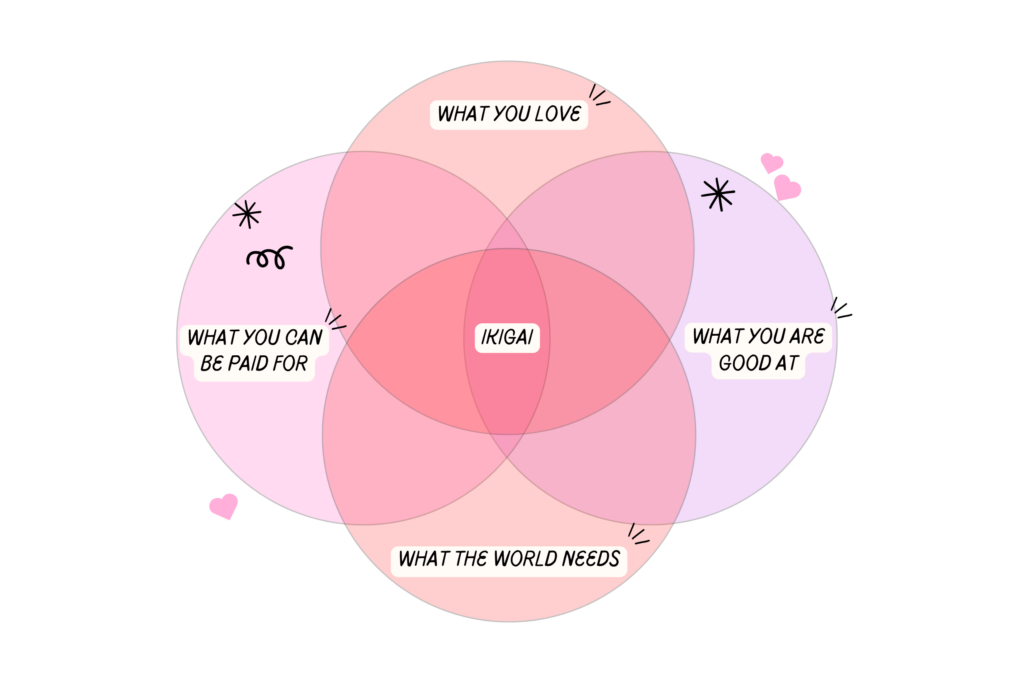
The idea of Ikigai gets more clarity when understood as a modern management tool. Popularly represented by a Venn diagram, Ikigai is considered at the centre of the cross-section of four different ideas:
- What you love
- What you are good at
- What you can be paid for
- What the world needs
These four questions help you clearly identify your passion, profession, vocation, and mission. Your Ikigai sits at the centre of these overlapping concepts.
10 rules of Ikigai
To understand how to find and cultivate your Ikigai while working a full-time job, you need to be familiar with what is called ‘The 10 rules of Ikigai.’
This modern interpretation encapsulates the 10 fundamental rules of the broader Ikigai philosophy. Let’s dive in:
Stay active and don’t retire
If you find your current job boring or if you are about to retire from work, you should know that your true freedom is in remaining active. Ikigai lets you stay engaged with what you love even during and after your work.
This brings purpose and meaning to life, eventually keeping you happy, joyful, and economically on a sound footing..
Take it slow
If you are in the process of identifying your Ikigai, know that it doesn’t happen overnight. Instead of skilling or upskilling at a frantic pace, you should take a slow path.
The idea is that you should not disrupt your life on a major scale. Rather, a slow path brings about the changes gradually and offers enjoyment and mindfulness at the same time.
Don’t fill your stomach
Overeating can cause health problems as well as keep you too full to feel like working. To stay active and keep working, you will need to pay attention to what and how much you eat.
This is as important for young working executives as for retired elders. Eating in moderation keeps you fit and passionate about your Ikigai.
Surround yourself with good friends
The concept of Ikigai is not one of isolation and pursuing your goal individually. Instead, it’s about social connection that has a big role to play in one’s emotional well-being.
Having well-meaning friends and family members with whom you can share your successes and setbacks is ultimately good for a joyful and contented life.
Get in shape for your next birthday
For staying physically fit and active, you would need to keep yourself in shape by embracing workouts, yoga, and meditation. These activities will also help you keep troubling thoughts and depression at bay.
They will make you look forward to your next birthday with a happy and healthy body. Eventually, you will not only experience improved health and fitness, but will also be able to work for your Ikigai.
Smile
A smile is a big-time positivity enhancer. Whether you are happy or facing setbacks, keep a smile on your face. It will remove negativity from your surroundings.
As you are going to work on your Ikigai, a smile is one of the most important tools to keep you and your circle of friends motivated.
Reconnect with nature
Connecting with nature helps reduce stress and adds to your happiness. Ikigai is not about fiercely chasing your goals but creating a balance between different factors impacting your life.
Connecting with nature by sitting outside and watching birds, leaves, and the sound of the blowing wind can do a lot of good to your mood and mind, helping you achieve the goals of your Ikiagi.
Give thanks
Saying a thank you removes distance and helps you connect with people easily. It expresses a kind of gratitude that does good for both you and others.
As you are working on your Ikigai that focuses on contentment and happiness, and at the same time success in your profession or hobby, saying thanks keeps you grounded with gratitude to others for the role they play in your successful Ikigai.
Live in the moment
One of the goals of Ikigai is to remove anxiety and stress and lead you to a life of purpose and mindfulness.
By living in the present, you can forgo the stress emanating from your past and the anxiety that comes from worrying about the future.
Ikigai teaches us to live in the moment so that we can be free from stress, anxiety, and all negative thoughts.
Follow your Ikigai
A key aspect of Ikigai is to find your passion and purpose in life. You should indulge in activities that the world needs and is ready to pay for.
However, Ikigai is more geared towards bringing a balance in your life than adopting a rigorous professional life. Being content and happy is one of the key goals. You should identify and pursue your Ikigai.
How to Find and Cultivate Your Ikigai While Working a Full-Time Job
One of the biggest challenges with a full-time job is that you don’t find sufficient time for other activities, such as your hobbies. And, the best part of Ikigai is that it doesn’t require more time than you can afford.
Ikigai is all about pursuing your passion with a balance.
However, it can be interesting to see how you can find and cultivate your Ikigai while working a full-time job.
Related Read: 5 Simple Tips to Balance a 9-5 Job and Mental Health
How to find your Ikigai?
Your Ikigai sits at the centre of four overlapping circles: What you love, What you are good at, What the world needs, and What you can be paid for. You need to think about these four questions and try to find your answers.
What you love?
Think about all that you love to do — travelling, photography, fishing, art, meeting people, solving problems, gardening, teaching, volunteering, and social issues.
Make a list of activities that bring joy and happiness to you. Then, pick the three activities that you love the most.
What you are good at?
Now, take a look at the list and see which activities you are good at. You can also make a separate list of activities that you are good at.
Now match the two lists of What you love and What you are good at. Do you find some activities that figure in both the lists? One of these could be your Ikigai. However, you need to test these activities on the two remaining parameters.
What the world needs?
Now, take a look around and try to find the answer to this question: What the world needs? Do some of the activities you love and you are good at are also what the world needs?
Depending on your worldview, you can make a list of what you think the world needs. Now, compare it with the two lists you have already made.
What you can be paid for?
Comparing the three lists you have, you can figure out what you can be paid for. Earning some money from what you love, what you are good at, and what the world needs can be a great idea.
Make a list of activities that you can be paid for. Now, compare the four lists and tick the activities that figure in all four lists. The common activity in all four lists could be your Ikigai.
Related Read: 5 Simple Steps to Create a Mindful Morning Routine for Working Professionals
How to cultivate your Ikigai while working a full-time job?
By the above-mentioned process, you would be able to identify your Ikigai. Now, the question is how to cultivate it while working a full-time job.
As mentioned earlier, one of the biggest challenges in cultivating an Ikigai while working a full-time job is finding time to pursue it. Here is how you can overcome this issue:
Plan it out
You have discovered your Ikigai – something that you love to do, that you are good at, that the world needs, and that you can be paid for. It’s a great achievement.
The only thing greater than this is to implement it and make it part of your life. This needs planning.
Try to plan out how you would pursue your Ikigai within the limitations that your full-time job entails. Planning will give you small windows of time when you can indulge in and cultivate your Ikigai.
Create a support network
Once you are set on the path of your ikigai, you should try to create a support network. Tell your friends and colleagues about your Ikigai and seek their support.
You may need mentors or coaches to skill up yourself. Depending on what your Ikigai is, you may need support from your family and friends. Let’s build a support network of people who encourage you to pursue your Ikigai.
Start small
Ikigai is not like corporate goals that you must achieve to stay in reckoning. It’s more of a pastime that gives you contentment and happiness.
It doesn’t have to start on a mega scale. Rather, you can break your Ikigai into several smaller milestones and go about accomplishing them.
Even 15-30 minutes of time blocks can be useful. You can listen to a relevant podcast during your commute, or a 15-minute project during lunch break can give you the head start you need.
Wrapping up
In traditional Japanese society, Ikigai is seen as the reason for which you get out of your bed in the morning. It’s a hobby or pastime that gives you contentment and enjoyment.
At the same time, it earns you money. Ikigai is believed to be one of the reasons why the Japanese have longer, healthier, and happier lives.
For someone who has a full-time job, pursuing Ikigai could look to be a difficult task. However, with proper planning, one could manage to integrate it into one’s life even with a 9-5 job.
The secret lies in planning it well, starting it small, and creating a support network of family, friends, and colleagues who encourage you to pursue your Ikigai.




Leave a Reply