


Sonia is a senior editor with a daily newspaper. Even at the age of 60, she drives 100 km every day to reach the office and return home.
Her approach is a clear example of perfectionism and work-life in action. Everybody in the office knows she is a tough taskmaster.
For all the six to seven hours when news keeps coming at a rapid pace, she is in a combative mood to deal with it, delegating to junior editors, monitoring the process, and ensuring everything is alright.
However, the question of how to live a mindful life while working a full-time job is a constant challenge.
Like with everything else in the world, some errors do creep into the newspaper pages, and that’s when she loses her cool and expresses her dissatisfaction with colleagues.
She expects everybody to emulate her dedication and hard work and make the pages absolutely flawless. It leads her colleagues to criticize her behind her back, something she is totally aware of.
Her lack of mindfulness regarding her own behavior and its effect on others contributes to the growing tension in the newsroom.
The result is a tense work environment where she doesn’t trust anyone, and no one likes her. During office hours, she hardly takes a break except once to eat from her tiffin in a lonely corner of the canteen. No one knows what she eats and whether that is enough for her.
She is aloof and has hardly any conversations outside work. Many people think she is lost to perfectionism, and she needs to create work-life balance, perhaps through an introspective practice like journaling.
While everyone else is enjoying snacks and coffee in the office canteen, she is buried in work at her desk. Is she suffering from a severe case of perfectionism and work-life imbalance that doesn’t allow her to enjoy her job?

What is Perfectionism?
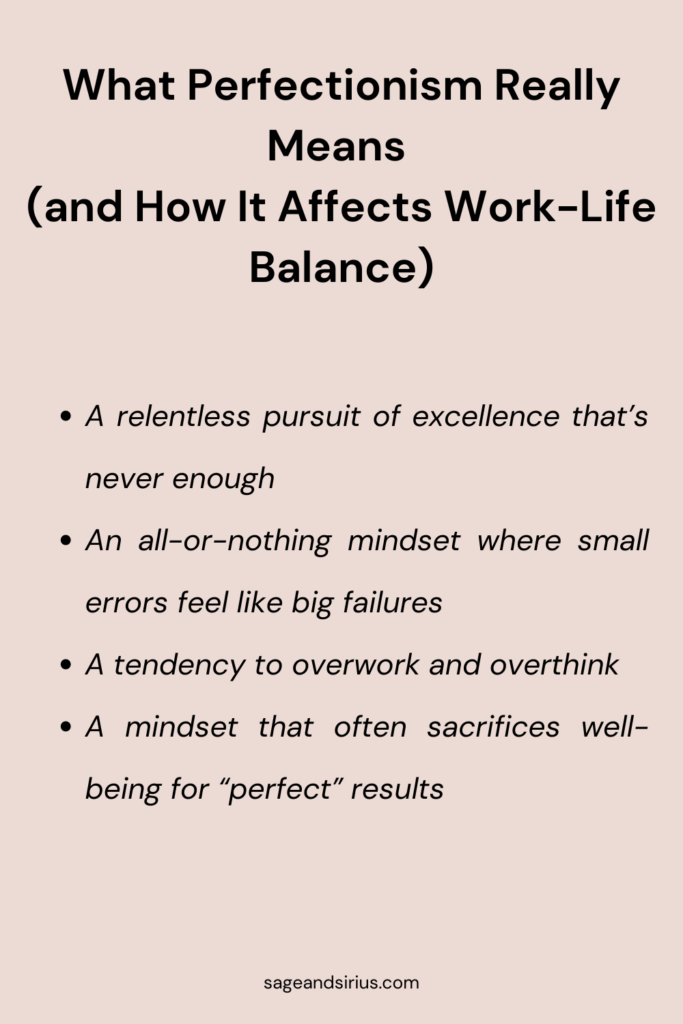
What is perfectionism? It’s a relentless and almost obsessive pursuit for excellence, which by all means is an elusive concept.
Usually, a person with a perfectionist approach would seldom be satisfied with their work as they set very high or unrealistic standards for themselves and others.
This is why practices promoting balance, such as Mindful Living and Self-care, are so important to counteract the stress and dissatisfaction that perfectionism can cause.
When it’s self-oriented, the person is not satisfied with what they have done or achieved. They would endlessly keep working and fine-tuning their work, thinking that anything less than the best is below par.
It’s an all-or-none mindset where even small errors are seen as failures.
When it’s other-oriented, they would find fault with others’ work. The perfectionist would expect that the people working with them should complete the job to their satisfaction, for which they set the bar very high.
Also, some workplaces and social groups keep the standards high and indulge in nitpicking.
Ultimately, the question is how to live a happy life. And the answer is that adopting healthy lifestyle habits is crucial to counteract this mindset.
We all try to excel in our work, but some of us are better and progress faster than the rest. Success at the workplace is always a combination of the right skills and hard work.
Communication and interpersonal relationships also play a vital role in our success.
While a combination of these attributes can make people perfect in their given fields, it’s the management of perfectionism and work-life that often determines whether you are headed to true happiness or burnout.
While the right skills are non-negotiable, hard work has its limits. Also, hard work can manifest in ways, and it may not always produce better results.
One of its manifestations is the pursuit of perfection. If not mindful, a pursuit for perfection can go too far, impacting your communication and relationships at work.
In this backdrop, understanding perfectionism in all its facets, including the disadvantages it may produce, is very important.
Perfectionism is the state of trying hard to get everything right. Having an eye for details is great, but when you start spending too much time on every detail, it can have an adverse impact, especially when you have deadlines.
Key Characteristics of Perfectionism
Unrealistic Standards
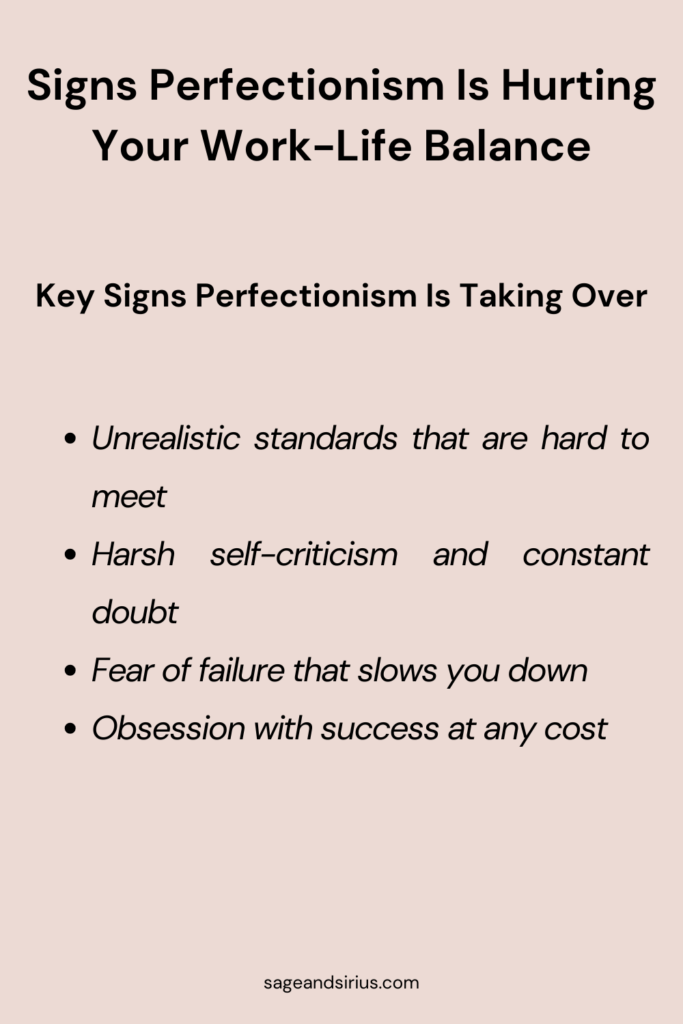
One of the most recognizable traits of a perfectionist is the unrealistic standards they set for themselves and others.
If you work with this attitude on every project, your work-life balance will be affected. It’s better to come up with a minimum viable product (MVP) rather than working endlessly to come up with a product that’s a hit right at its launch.
This strategic approach is crucial for anyone trying to figure out how to live a mindful life while working a full-time job.
Harsh Self-Criticism
A perfectionist would look at things from a critic’s point of view, if not entirely with skepticism.
It leads to perpetual self-criticism, which over time can become harsher and harsher, and it can have an adverse impact on your work-life balance.
Fear of Failure
Another negative aspect of a perfectionist is the constant fear of failure. In an office, when you approach work as a perfectionist, you fear not achieving the desired goal or being criticised for poor quality.
It’s just the fear! In reality, your colleagues and superiors might admire your dedication and sincerity.
Obsession with Success
There are many examples where failures turn out to be lessons for bigger successes. Being successful in everything you do is just wishful thinking.
However, perfectionists would think that elaborate planning and hard work can always produce great results.
Although it seems logical, it’s not always the case. Success may depend on many other factors on which you may not have control.
How Does Perfectionism Affect Work?
While perfectionism at the workplace could be viewed as a positive personality trait with strong work ethics and high standards, the practice of Mindfulness and Journaling can be crucial for managing the many adverse consequences it may cause.
Here are a few of them:
Procrastination
When standards are high and nothing less than the best is acceptable, it can lead to delays due to over-analysis.
Due to fear of not being able to secure the best result from their efforts, people with the perfectionist approach could resort to procrastination.
Little Scope for Creativity and Innovation
It’s through hits and misses that teams achieve creativity and innovation. Perfectionism doesn’t give a chance to take risks, think out of the box, or carry out experiments for fear of making mistakes. Eventually, it could mean reduced creativity and innovation.
Increased Stress and Burnout
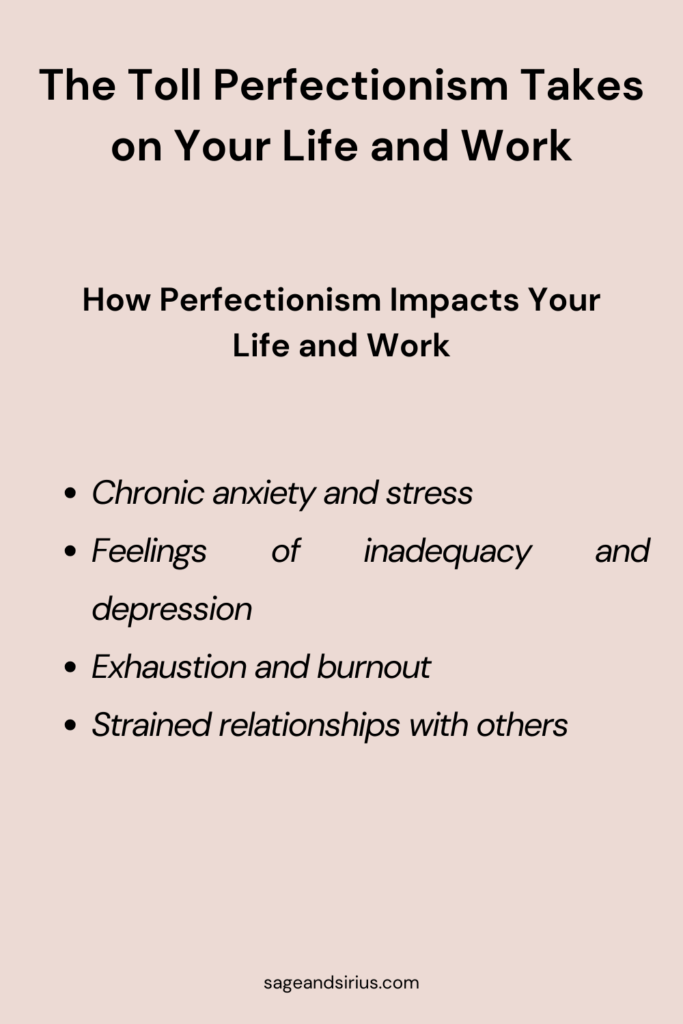
Perfectionism takes its toll on your emotions and physical health. Looking at your work critically all the time and trying to fix every minor problem can lead to anxiety and stress, and in the long term, it can even lead to burnout.
Poor coordination and Strained Relationships
Teams work and collaborate on the basis of their individual merit. It’s each member’s capability, skills, and resilience that make the team shine and achieve higher goals.
Perfectionism, with its overly critical approach, can stifle other voices in the team. It can strain relationships and stifle collaborative spirit.
What Is the 70/30 Rule for Perfectionism?
Achieving 100% perfection is somewhat too much, you would agree! So, how much perfection is good enough?
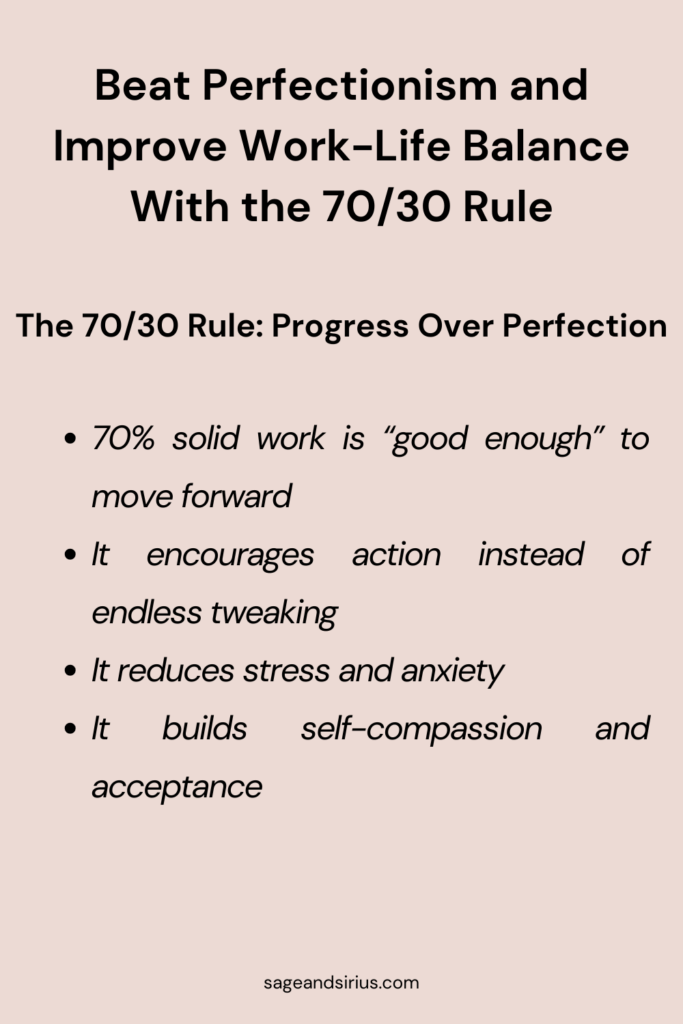
According to the 70/30 rule, achieving 70% perfection is good to go. Spending hours and days trying to make the remaining 30% absolutely flawless is avoidable, as 70% of the solid work itself is quite an achievement.
For the remaining 30%, you can depend on the team members and seniors to suggest how to tackle it. This approach is key to practicing self-care and finding out how to live a happy life.
Here are some of the advantages of the 70/30 rule:
It Encourages Action and Progress
One of the drawbacks of perfectionism is that it leads to fear of not being 100% perfect. This, in turn, results in procrastination and, in some cases, you feel like avoiding the project altogether.
However, when you are guided by the 70/30 rule, it lets you feel free once you have done your bit. This approach expedites your ability to take on new projects and finish them in time.
It Reduces Stress and Anxiety
Once you embrace the 70/30 rule, you unburden yourself from achieving 100% perfection, which is more elusive than real.
It removes the stress and anxiety that your work can cause when you try for absolute perfection.
It Builds Self-Compassion
If you are a workaholic and a perfectionist, acknowledging that you, as a human being, will make mistakes can certainly help you.
Achieving 100% perfection may be possible, but it should not come at the cost of all the trauma and suffering you may have to go through for this.
Accepting yourself for all the mistakes you can make will help you build self-compassion and self-acceptance.
What Are the 3 P’s of Perfectionism?
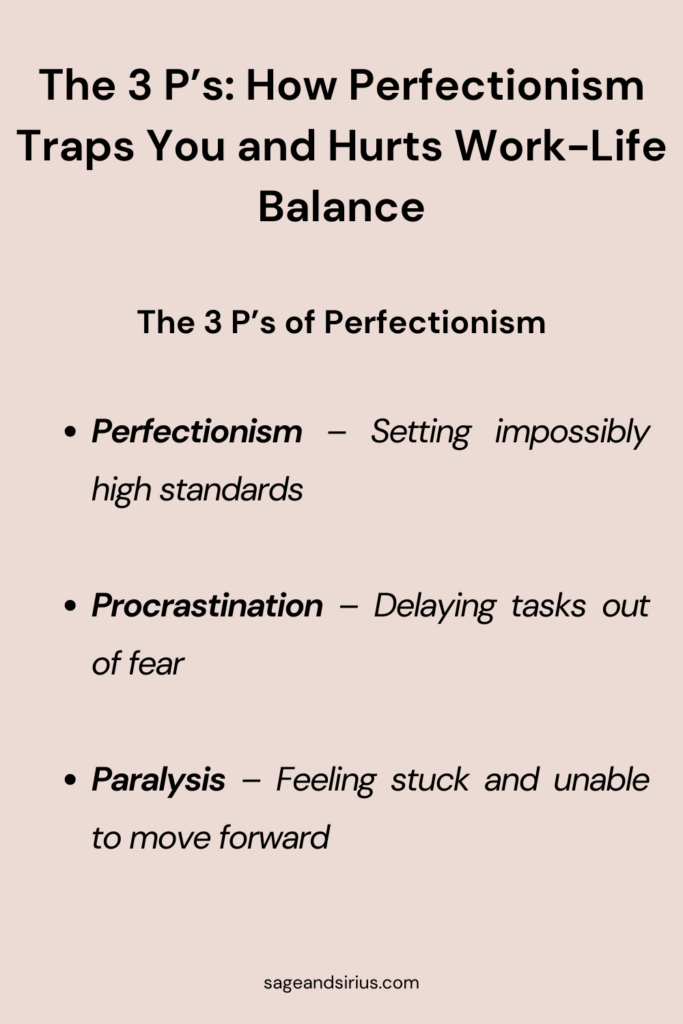
The three P’s of perfectionism are Perfectionism itself, Procrastination, and Paralysis. It’s a trap-like circle where one leads to the other, and you are never able to come out of it.
To break free from this cycle, you must build mindfulness and other healthy lifestyle habits. Let’s see how it plays out:
Perfectionism
You set a very high standard for yourself and others, and you are not ready to accept anything unless it’s 100% perfect.
It creates complications at the workplace, including a constant fear of failure. It hurts your and the team’s self-esteem.
Procrastination
When the bar is set very high, you get overwhelmed. You feel you can’t complete the work with the quality parameters you set for it.
It causes you to delay the start, and when you do start, it causes you delays as you are always stuck fine-tuning small things.
Paralysis
Perfectionism and procrastination lead to a paralysis-like situation, where you fail to move forward on a task. If you don’t work on a task, it gets all the more overwhelming as time passes.
And, you start blaming yourself or the team.
How Does Perfectionism Impact Your Life?
The impact of perfectionism affects our life in many ways. It can cause mental, emotional, and professional distress.
The relentless pursuit of an ideal that’s never reached is the core issue of perfectionism and work life. It’s a key barrier to figuring out how to live a mindful life while working a full-time job.
Here are some of its adverse effects on you:
Anxiety and Stress
When you are working to produce flawless results, you are under great pressure. It can show up in several undesirable ways. You may feel extreme anxiety and stress.
Depression
In a perfectionist’s scheme of things, the standards are unrealistically high. It causes failures which can further cause a feeling of worthlessness and hopelessness.
When it happens over a long period, you get depression, a chronic feeling of inadequacy and sadness.
Burnout
A perfectionist often works too hard and spends little time on self-care.
Due to constant emotional, mental, and physical stress, they feel exhausted and lose the drive to work, causing them to abruptly stop working, a state known as burnout.
Strained relationship
People with perfectionist attitudes often criticize their colleagues for failing to produce perfect results. In the process, they also get negative reviews.
This cycle continues with the result that nobody is happy or satisfied, creating strained relationships.
Wrapping Up – How Perfectionism Affects Your Work-Life Balance
In the case of Sonia, she was lucky to find a website that focused on creating work-life balance and made her aware of her perfectionist attitude.
As she found many of the blogs on the site had a deep connection with her, she spent more time learning how to live a mindful life while working a full-time job.
Her life changed for the better after she started journaling her work-life, fears, failures, and the driver for perfection.
On the face of it, perfectionism drives you to achieve higher standards in your work. One success, and you know what it takes to be successful.
It can motivate others, too, to work hard and secure high-level goals in their respective lives and careers.
However, when perfectionism and work life become intertwined as a core personality trait, you try to painstakingly fix every minor detail to ensure your work is flawless and meets the highest possible standards.
You don’t want to be any less successful than on the previous occasion. This ultimately adversely impacts your well-being and work-life balance. For these reasons, perfectionism is not a healthy motivator.
As a perfectionist, you are deeply involved in your work, trying to make sure that everything is correct and of high standards.
In this backdrop, when you get to hear a criticism, it hurts you. It causes a constant fear of failure that you want to avoid at any cost.
Perfectionism makes you slow, as you don’t want to take the risk of being wrong. When you start doing this with everything you do, the speed is a casualty.
When this happens with a company or project, it impacts the growth.




Leave a Reply